
Google I/O 2026: Redrawing Search, Apps, and Desktop with 'Agentic Gemini'
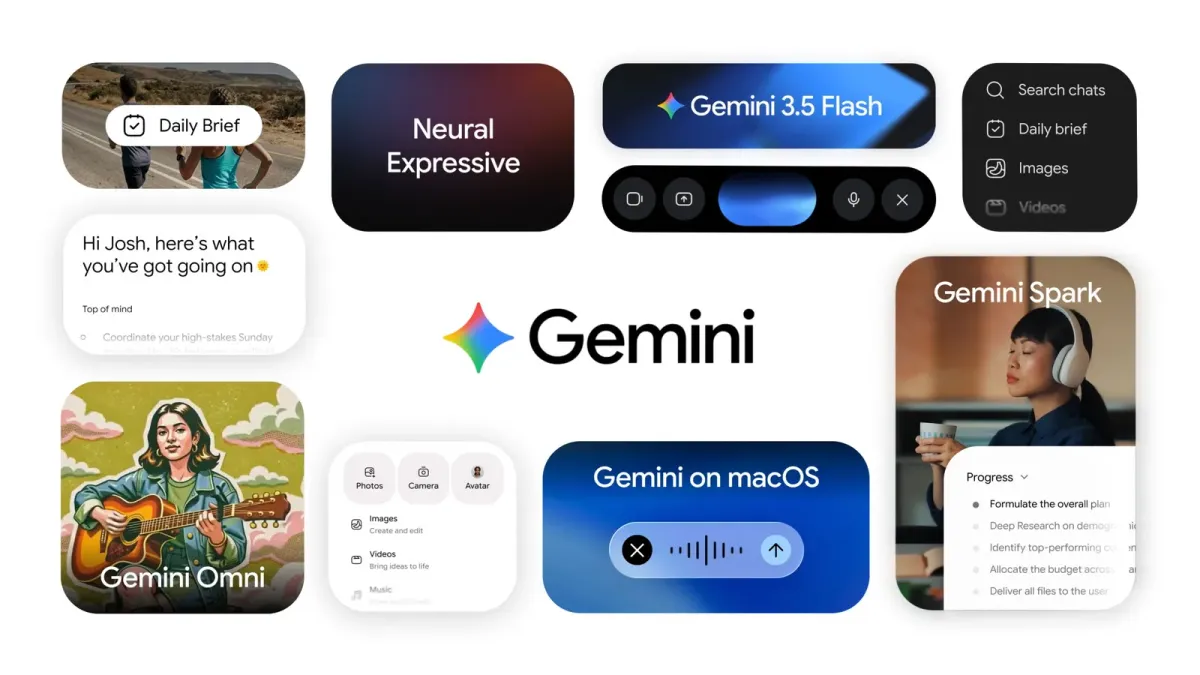
At Google I/O 2026, Google unveiled its 'agentic Gemini' ecosystem. It features Gemini 3.5 Flash, 24/7 autonomous agents, and a redesigned Search box.
Google I/O 2026 opened on May 19 at the Shoreline Amphitheatre in Mountain View, with CEO Sundar Pichai framing the event as the dawn of the 'agentic Gemini' era. Google now processes 3.2 quadrillion tokens monthly across its services—a seven-fold increase from the 480 trillion reported just a year ago. Annual capital expenditure has surged from $31 billion in 2022 to an estimated $190 billion this year. The keynote introduced the first redesign of the Google Search box in 25 years, deployed 24-hour autonomous agents under the agentic Gemini ecosystem across desktop, mobile, and smart eyewear, and validated the pre-event reporting by bringing those announcements onto the main stage.
The 3.2-quadrillion-token stage
Tracking this token growth reveals the massive scale of Google's infrastructure expansion. Two years ago, monthly volume stood at just 9.7 trillion tokens, which rose to 480 trillion last year, before reaching the current 3.2 quadrillion—representing a near order-of-magnitude leap with each annual cycle. Model APIs alone now process approximately 19 billion tokens per minute.
Supporting this traffic is a colossal global user base. Thirteen Google products now exceed one billion monthly active users (MAUs) each, with five surpassing three billion. AI Overviews serves 2.5 billion monthly users, while the conversational AI Mode has crossed the one-billion mark within a year of its launch. Additionally, 8.5 million developers build on Google's models monthly, and 375 Google Cloud enterprise customers have each processed over a trillion tokens in the past year.
On the infrastructure side, capital expenditures (capex) reflect the scale of these operations. Annual capital spending has grown from $31 billion in 2022 to approximately $190 billion this year. Pichai cited these figures during the Google I/O 2026 keynote to support his claim that the AI cycle has reached a mature phase where users expect to see tangible, everyday value in consumer products.
Gemini Omni — generating any output modality from any input

The foundational engines driving this ecosystem are split into two paths. Gemini Omni is a native multimodal model capable of generating any output modality from any input. While Google is launching Gemini Omni with a focus on real-time video generation, plans are in place to expand its direct output capabilities to image and text. Integrated with the Veo video stack, Gemini Omni can accept mixed text, image, and video inputs to perform complex editing tasks like cinematic zooming or background replacement from a single natural-language prompt.
Gemini 3.5 Flash — frontier intelligence with action
Operating in the high-efficiency lane is Gemini 3.5 Flash. Described at Google I/O 2026 as 'frontier intelligence with action,' it is the first release in Google's next-generation model family. It outperforms Gemini 3.1 Pro across almost all standard benchmarks while running four times faster than competing frontier models at less than half the cost. Google estimates that if top-tier enterprises migrated 80% of their current frontier workloads to 3.5 Flash, they would realize roughly $9 billion in combined annual savings.
This cost-and-performance narrative is backed by Google's internal adoption metrics. In March, the company's internal AI development tools processed 500 billion tokens daily; by the keynote, that figure had ballooned to 3 trillion tokens per day—a six-fold increase in just two months. The model presented on stage is one Google has thoroughly battle-tested across its own engineering teams.
Spark — a 24/7 autonomous agent on the Antigravity harness

Leveraging Gemini 3.5 Flash is Gemini Spark, which marks a major shift from passive conversational assistants to 24/7 agentic Gemini autonomous agents. Operating on Google's Antigravity 2.0 orchestration framework, Gemini Spark runs persistent background workflows and integrates deeply with Google Workspace applications such as Gmail, Docs, Slides, and Calendar.
In real-world scenarios, Gemini Spark can automatically analyze monthly credit card statements to isolate new recurring subscription fees, or scan school email inboxes to extract critical deadlines and compile them into a daily digest for parents. It can also aggregate meeting notes from various email and chat threads to draft a cohesive Google Docs report and an accompanying company blog post. To ensure safety, high-stakes actions such as processing financial transactions or sending outbound emails require explicit user confirmation.
Daily Brief and macOS extend the assistant line
Daily Brief is the other half of the same loop. This morning digest builds on Google Labs' experimental 'Project CC' and has transitioned into a commercial product. Once a user opts in, the agent operates in the background across connected applications to consolidate critical updates, calendar events, and pending tasks onto a single screen. Gemini Spark rolls out to trusted testers this week and will enter beta for US Google AI Ultra subscribers next week. Daily Brief is also scheduled for a phased rollout starting in the US.
Google also released an updated macOS version of the Gemini app, signaling its intention to bring Gemini Spark's full desktop orchestration capabilities to Apple's ecosystem. With Anthropic's Claude Cowork already establishing a strong foothold on Windows, the competitive pressure to secure the desktop agent layer was a visible undercurrent of the presentation.
Search box, redesigned for the first time in 25 years

The agent-driven paradigm shift is most pronounced in Google Search's AI Mode. VP of Search Liz Reid explicitly called this update the 'first redesign of the search box in 25 years.' Under the hood, Gemini 3.5 Flash has been deployed as the global default model powering Google's conversational AI Mode.
The new search box in AI Mode transforms the traditional static keyword field into a dynamic input workspace. It expands automatically to accommodate complex, multi-modal queries, accepting text, images, raw files, video clips, and even active Chrome tabs. Follow-up inquiries from an AI Overview transition seamlessly into an interactive AI Mode conversation while preserving the full contextual history of the session. The global rollout begins immediately across all regions and languages where AI Mode is currently supported.
Search agents and Antigravity coding inside Search
The most transformative addition is search agents, which allow users to create and manage custom information-gathering agents directly within Search's AI Mode. These agents operate autonomously 24/7, querying web sources, application interfaces, and digital services. For instance, a booking agent can process a detailed request like 'private karaoke room for six on Friday night with late-night food options' and return precise pricing, live availability, and direct booking links. In highly localized service sectors like home maintenance, beauty, and pet care, Google can even place automated phone calls to local merchants on behalf of the user to confirm details.
Additionally, the agentic coding capabilities of Google's Antigravity 2.0 framework have been integrated directly into the Search response layer. The platform can now generate custom user interfaces on the fly, rendering tailored visualizations and interactive simulations based on the user's query. Recurring tasks like planning a wedding or organizing a move now receive a custom dashboard the user can return to at any time—functioning as a mini-app embedded directly within Search's AI Mode.
Antigravity 2.0 and Managed Agents in the API

Enabling search agents with this level of autonomy requires robust underlying developer tooling. Antigravity 2.0 expands Google's developer ecosystem from a simple coding environment into a comprehensive platform for building, testing, and managing cohorts of autonomous AI agents. At the heart of this suite is a standalone desktop application serving as the central orchestration hub, powered by a specialized Gemini 3.5 Flash variant optimized to run twelve times faster than competing frontier models.
The Gemini API has also been upgraded with Managed Agents, simplifying agent lifecycle management for developers. Simultaneously, Google AI Studio now features native Android integration, allowing developers to engage in 'mobile vibe coding' directly on target devices. The overarching theme of the developer track was crystallized in a single directive: to accelerate the industry's transition from prompts to action.
Android XR and intelligent eyewear
The second axis of Google's platform strategy is Android XR, highlighted by the unveiling of two distinct intelligent eyewear form factors: audio-only glasses that provide localized spoken assistance, and display glasses that overlay digital information directly onto the user's field of view. The audio-focused glasses are scheduled to ship first this fall, developed in partnership with Samsung, Qualcomm, Gentle Monster, and Warby Parker. Users can trigger Gemini via a 'Hey Google' voice command or a physical tap on the frame to receive hands-free assistance with navigation, real-time translation, and environmental object identification.
While 'Agentic Gemini' served as the Google I/O 2026 keynote's primary marketing narrative, the true takeaway of the two-hour presentation was the cohesive alignment of Google's entire vertical stack. By introducing synchronized updates across model architectures like Gemini Omni, agentic Gemini autonomous agents, search infrastructure, operating systems, and physical hardware, Google demonstrated its unique ability to execute a unified, full-stack AI strategy in a single day.
- Google Blog - Sundar Pichai's keynote at Google I/O 2026
- Google Blog - Search, supercharged: our biggest updates at I/O 2026 — Liz Reid
- Google Blog - Google I/O 2026: Developer keynote highlights
- Google Blog - The next evolution of the Gemini app — Spark, Daily Brief, Omni
- Google Blog - Android XR and intelligent eyewear at I/O 2026