Muse Spark 1.3: My Best-Value Coding Model

Muse Spark 1.3 is a low-cost coding worker on Contributor terms. Compare Meta pricing, OpenCode Go's $10 plan, limitations and required data sharing.
Table of Contents
Meta's Muse Spark 1.3 costs $0.10 per million input tokens and $0.20 per million output tokens on its Contributor tier. That price makes the newly released coding worker worth considering for frequent implementation work, provided sharing the work for model training is acceptable.
The combination of implementation ability and cost is what stood out in my use. My best-value verdict is a personal recommendation for choosing a coding worker at Contributor pricing, not a ranking from controlled tests of every model. Prices, the OpenCode Go subscription and training data sharing conditions below were checked against official documentation on September 9, 2026.
Muse Spark 1.3: Meta's September Update
Meta released Muse Spark 1.3 on September 2 with improvements to coding and agent workflows that use tools across multiple steps. It is available through Muse Code and the Meta Model API. The focus extends beyond generating answers to carrying out work in an agent environment.
In its official announcement, Meta reported roughly 20% fewer tool calls and 25% fewer tokens than version 1.2 in comparisons by its engineers. Those are Meta's own results, not a promise of equal savings on every task. They show an emphasis on reducing the work and cost needed to complete coding tasks.
Shortly after release, OpenCode founder dax posted that Muse Spark had displaced DeepSeek as the most-used model of the day. We covered the initial response in our earlier OpenCode usage article. Usage is not a performance ranking, but it provides context for the attention the model is receiving.
Contributor Pricing Requires Training Data Sharing
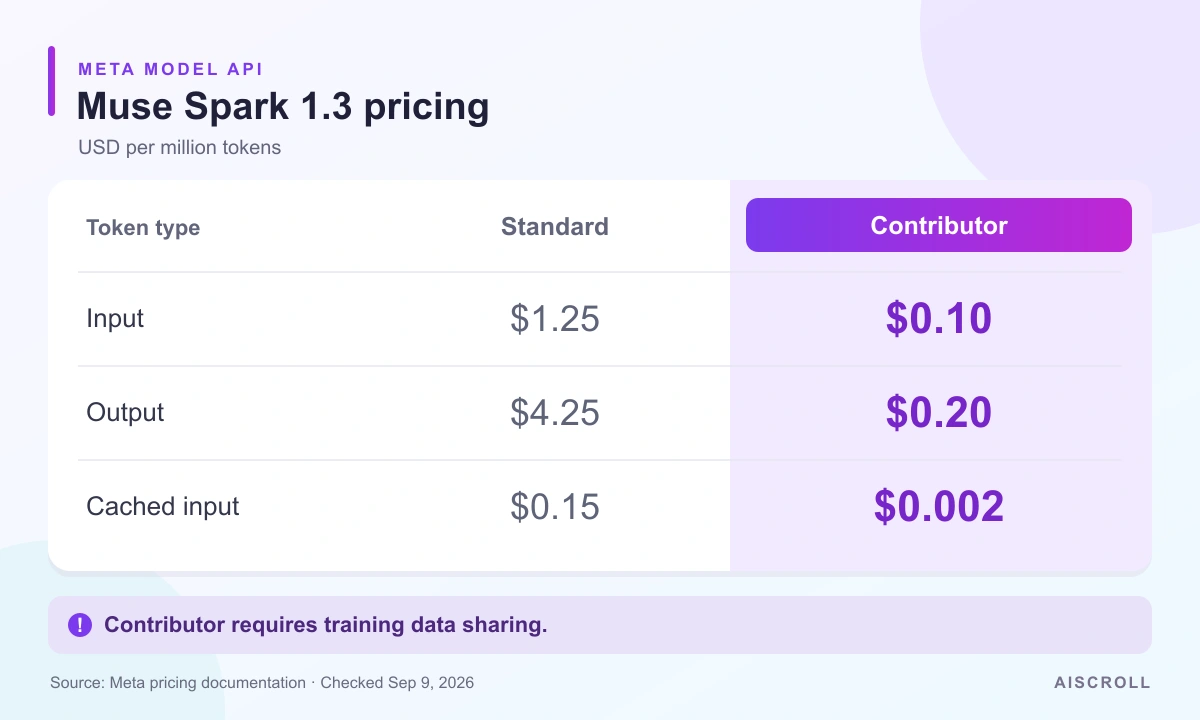
Contributor is Meta's pricing tier, not a discount tier invented by OpenCode. Meta's pricing documentation explicitly exchanges lower rates for permission to use prompts and completions to train future Meta models. Standard and Contributor access therefore need to be considered separately.
| Tier | Input | Output | Cached input | Training policy |
|---|---|---|---|---|
| Standard | $1.25 | $4.25 | $0.15 | Prompts and completions not used for training |
| Contributor | $0.10 | $0.20 | $0.002 | Permission to train on prompts and completions |
Using the Contributor model requires permission to share data. Where the service exposes a training data sharing option, that option must be enabled. Training data sharing covers prompts, submitted code and model responses that may be used to train Meta models. It is not merely permission to collect anonymous usage totals.
On OpenRouter, check the provider-training permission in privacy settings. Its documentation distinguishes permissions for free and paid models. Opting out prevents requests from being routed to providers that train on the data, so the appropriate permission must be enabled for Contributor access.
For an OpenCode Go subscription, the provider also identifies this model as training-enabled and not zero-data-retention. Low pricing is not permission to submit confidential company code or personal information. If training data sharing is prohibited for the material, this recommendation does not apply to that work.
Strong Implementation, a Better Worker Than Lead
Implementation was the part I liked most. When the work to be built was defined, the model could do its job. I found it useful as a coding worker in orchestration, where multiple models take different roles.
Language ability was less satisfying, and its view of the task sometimes felt narrow. There was a gap between implementing the immediate request and judging what matters across a broader context. In my use, this coding worker fit a bounded role better than a general replacement for the top frontier models.
My suggested setup is to let a stronger model own the overall direction, task assignment and final review, while Muse Spark 1.3 serves as the coding worker. The point is to give the coding worker more scoped implementation, not to hand over every decision because it is cheap. This is a workflow recommendation from hands-on impressions, not a separate quantitative benchmark.
Free on Zen, Generous Allowances on $10 Go
For an initial trial, OpenCode Zen lists Muse Spark 1.3 Contributor Free. The Zen documentation describes it as a limited-time free offering. This is separate from a Go subscription: try it within the available free allowance before deciding whether to subscribe. The public documentation does not specify a fixed free quota, so unlimited access should not be assumed.
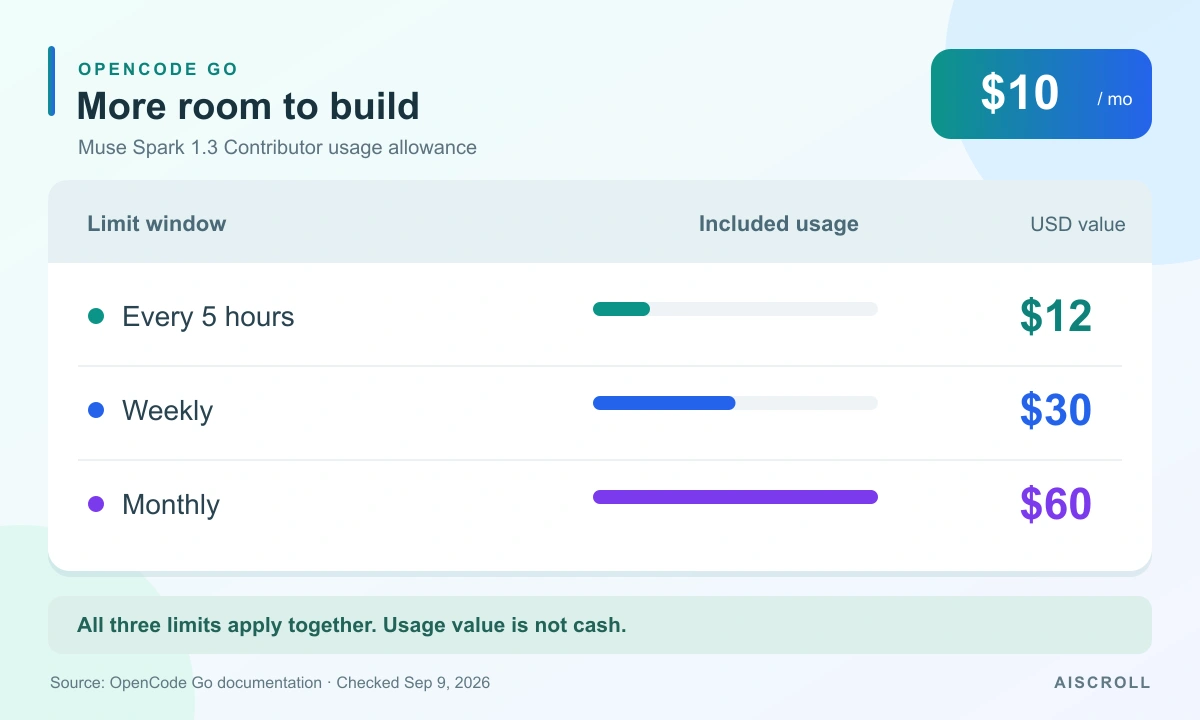
An OpenCode Go subscription is attractive for regular use. It costs $10 per month and includes the Contributor model within Go's own usage limits. Meta provides the model and discounted token rates; OpenCode separately sets the usage allowance included in its subscription. The current allowance for this model is particularly generous.
| Item | Published allowance |
|---|---|
| Subscription | $10 per month |
| Five-hour limit | $12 of usage |
| Weekly limit | $30 of usage |
| Monthly limit | $60 of usage |
| Estimated requests | 45,300 per five hours / 226,600 per month |
All time-window limits apply together. Dollar-denominated usage is not cash or refundable credit, and the request counts in Go's documentation are estimates rather than guarantees. For Muse Spark, the calculation assumes 620 new input tokens, 71,400 cached input tokens and 300 output tokens per request. Less cache reuse or longer outputs will reduce the actual request count.
To start an OpenCode Go subscription, subscribe with an OpenCode account and obtain an API key. In OpenCode, use /connect to select OpenCode Go, then select Muse Spark 1.3 Contributor through /models. Other coding agents can also use the service, subject to client requirements. Go lists regional restrictions under Meta's geographic policy for this model.
For pay-as-you-go access instead of a subscription, OpenRouter's Contributor model is another option. Its model ID is meta/muse-spark-1.3-contributor, distinct from Standard. Choosing a different billing route does not remove the requirement to allow training data sharing.
A Cheap Worker Today, More to Expect From Meta
I recommend Muse Spark 1.3 not because it leads in every capability, but because a coding worker costs so little on Contributor terms despite its weaknesses. The current allowance on an OpenCode Go subscription makes frequent use even more appealing. For work eligible for training data sharing, it is worth trying as a low-cost implementation worker.
That endorsement does not extend equally to Standard API pricing or Meta's regular subscription products. Different costs change the comparison with other models, and I find it less compelling without the Contributor economics. This recommendation rests on the combination of discounted pricing and implementation ability in actual use.
Meta's 1.3 announcement also previewed bigger models and a Muse Spark open-weights release. Timing and performance remain to be seen. If future models pair this implementation ability with stronger language skills and broader contextual judgment, they could take on more roles. For now, I recommend an inexpensive coding worker; Meta's next models are something I look forward to.

- Meta AI Research - Introducing Muse Spark 1.3
- Meta - Pricing and rate limits — Contributor tier
- OpenCode - Go — Usage limits and privacy
- OpenCode - Zen — Free models and privacy
- OpenRouter - Muse Spark 1.3 Contributor
- OpenRouter - Provider Logging — Training on Prompts
- dax / X - Muse Spark becomes the most-used model of the day on OpenCode