3 Coding Agent Picks for September 2026
Paseo for remote panels, Orca for isolated parallel work, and DeepSeek Harness for flexible plugins: three September 2026 picks and who each suits.
Table of Contents
Running several Codex or Claude Code sessions creates work beyond choosing a model. Someone has to track each agent's progress, keep concurrent file changes from colliding, and add missing capabilities. Management tools build on the default apps and CLIs to address those needs.
Orchestration coordinates work across agents; mixing models and agents adds another management choice. Assigning planning, implementation, and review to different agents requires more than dispatching tasks. Their progress and results need to stay manageable too.
Those needs shape these three coding agent tools for September 2026: Paseo for remote access and multiple panels, Orca for isolated parallel work and remote development, and DeepSeek Harness for flexible plugins. The comparison draws on official documentation and release notes to identify how each manages agents and whom it suits.
From agent management to the runtime itself
The three projects address different parts of working with agents. Paseo and Orca run and manage existing CLI agents such as Claude Code, Codex, and OpenCode. Familiar agents stay in place while the surrounding app adds an interface for multiple sessions, remote access, and task management.
DeepSeek Harness works further inside the stack. It assembles the agent runtime that calls models and uses tools from plugins, allowing developers to add capabilities or change behavior. After choosing model capabilities and subscription limits, there is still a choice between improving the management environment and changing execution itself.
Paseo: remote access and panels in one place
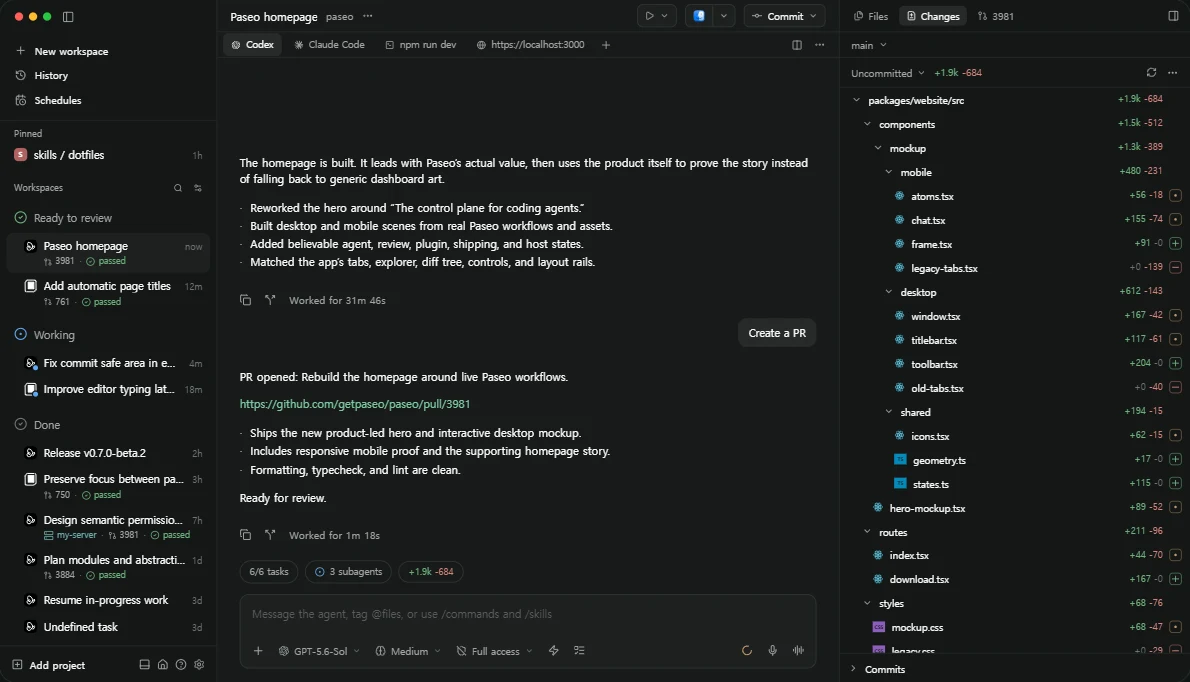
Image source: Paseo official website
Paseo brings several agents' progress into one place and makes that work accessible remotely. Its multi-panel layout puts sessions side by side, reducing the need to switch between terminal windows. The strength is a more convenient environment around existing agents.
The late-August update illustrates that direction. Version 0.7.0, released on August 31, added SSH connections to existing remote daemons from desktop and CLI. It also introduced plugin installation from Git repositories and changed the license to Apache-2.0.
Orchestration connects the agents as well as displaying them. The official documentation gives the example of Claude Code delegating a task to Codex. Different agents can handle different tasks while their progress remains visible in the same app.
Paseo suits users who keep several sessions open in panels or check running tasks as they move between home and the office. On Windows, version 0.7.2, released on September 2, fixed agent processes being left behind during daemon shutdown and restart. That makes the installed version worth checking when setting up remote work.

Orca: separate tasks across local and remote work
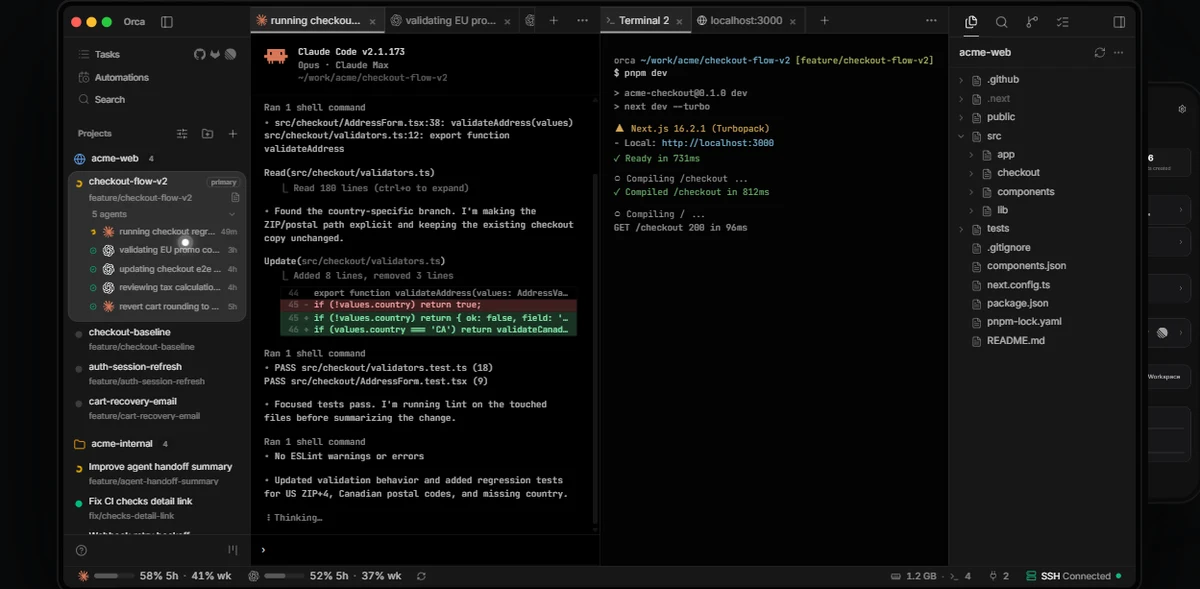
Image source: Orca official website
When several agents edit code at once, keeping their changes apart becomes important. Stably's Orca is strong at that separation. The official repository describes sending one prompt to five agents in separate Git worktrees and comparing the results. Worktrees provide different working directories and branches within the same repository.
That setup extends to remote development. SSH worktrees support file editing, Git, and terminals on a remote machine, along with reconnection and port forwarding. Managing local and remote tasks in the same app is a strength alongside parallel execution.
Orca suits developers handling several features or fixes concurrently, or asking different agents to solve the same task and comparing their results. Terminal splits and Claude and Codex usage tracking help keep that work manageable.
Check instruction handling and session recovery before adopting it. Orca's orchestration guide directs dispatched agents to follow added coordination instructions. Issue #1158 reports empty tab state being saved after a failed session restoration. Alongside compatibility with existing harness instructions, check the fix status of your version and its backup procedure.

DeepSeek Harness: an extensible option beyond Pi
Image source: DeepSeek Harness official repository
While Paseo and Orca manage work around existing agents, DeepSeek Harness is closer to a way of assembling the agent itself. Flexible plugin and extension composition makes it worth investigating as an alternative for developers who have built their own environment around Pi.
The important distinction is how much can be replaced. According to the architecture documentation, model adapters, the tool registry, session logs, and the agent loop are all Cordis plugins. Configuration can change core execution components as well as add tools.
Profiles cover the web app, one-shot execution without a server, SDK use, and ACP connections. Developers choose an execution form and compose what it needs. Session logs are designed to reconstruct what reached the model, providing a way to trace behavior while developing extensions.
DeepSeek Harness suits developers implementing tools or model integrations, or changing an agent's behavior in detail. Learning the profiles and plugin composition takes effort, but it opens up changes that a finished app's settings may not allow.

Start with remote management, parallel work, or extension
| Tool | Main strengths | Best fit |
|---|---|---|
| Paseo | Remote access and multiple panels | Users monitoring several sessions or checking progress from another device |
| Orca | Isolated parallel work and remote development | Developers working on several changes at once or comparing agents' results |
| DeepSeek Harness | Flexible plugin and extension composition | Developers exploring a Pi alternative or extending models, tools, and execution |
Mixing agents does not mean everyone needs the same environment. Paseo is worth looking at when monitoring progress comfortably is the priority. Orca is a stronger fit when keeping concurrent file changes apart matters most. DeepSeek Harness offers a different starting point for developers implementing the capabilities they need inside the agent.
Some features overlap, but the intended ways of working differ. Identifying whether the current need is remote management, parallel work, or plugin-based extension gives a clearer basis for choosing coding agent tools.


- Paseo - Releases — v0.7.0 (Apache-2.0, SSH remote daemons), v0.7.2 (Windows daemon fixes)
- Paseo Docs - Orchestration — cross-provider subagents
- Stably - Orca — the ADE for working with a fleet of parallel agents (README)
- Stably - Orca skill-guides/orchestration.md — injected preamble is authoritative
- Stably - Orca issue #1158 — silent data loss when workspace session hydration fails
- DeepSeek Harness - Architecture reference — Cordis plugins, profiles, bundles