
Cursor Composer 2.5: Frontier-Class Coding at One-Tenth the Cost
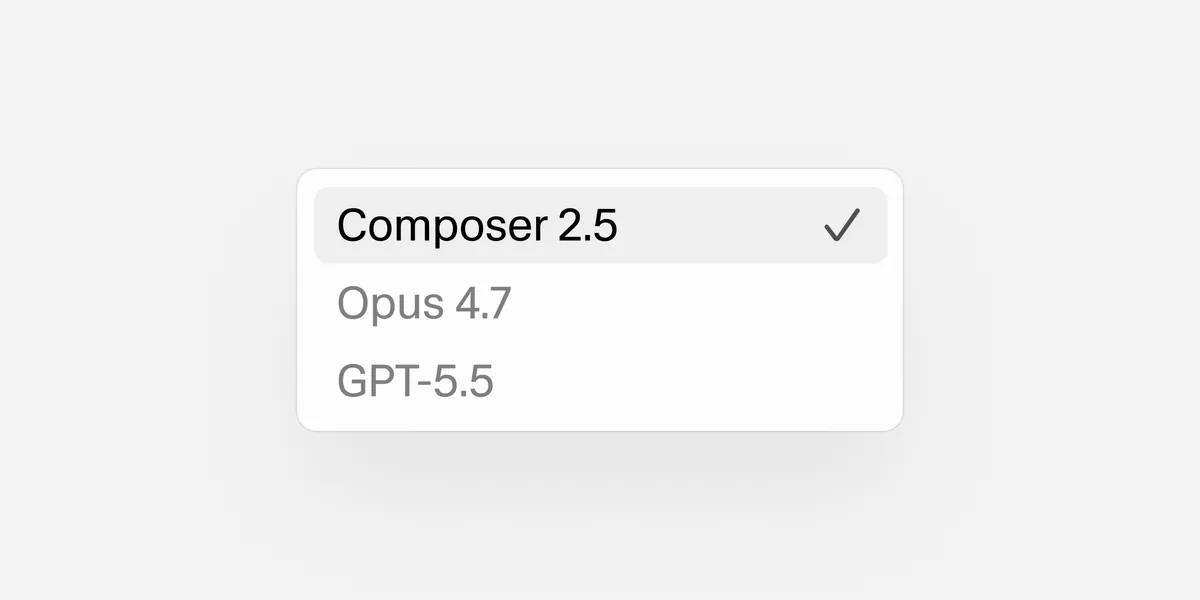
Cursor released Composer 2.5 on May 18, delivering frontier-class coding at one-tenth the cost. Built on Kimi K2.5, the fast, in-house model adds momentum to a company already surging amid rapid revenue growth and a potential SpaceX buyout.
Cursor released its in-house coding model, Composer 2.5, on May 18. The update promises frontier-class coding performance at roughly one-tenth the token cost, with the company making the fastest-responding 'Fast' mode the default setting.
The launch arrives at a critical juncture. Cursor is already seeing explosive annualized revenue growth and frequent acquisition chatter. A fast, cost-effective in-house model acts as an accelerant for the business. Within hours of the release, X filled with developers calling Composer 2.5 the best tool they had used.
Speed Built on Kimi K2.5
Cursor noted on its blog that Composer 2.5 is stronger at sustaining long-running work and follows complex instructions more reliably than its predecessor. The update ensures the code agent loses its way less often across the dozens of autonomous steps a real task demands.
The model's lineage is notable. Composer 2.5 was not built from scratch; it uses Moonshot AI's open Kimi K2.5 model as a foundation, layering Cursor's own post-training and reinforcement learning on top. Taking a powerful open-weight release and refining it for a specific environment allowed Cursor to capture both speed and cost efficiency in a single move.
Cursor also promoted 'Fast' mode to the default setting. Standardizing on the configuration that returns answers quickest represents a deliberate bet on an in-editor coding experience that reacts instantly.
Where the Benchmarks Place Composer 2.5

Speed and cost mean little without code quality, a metric where Composer 2.5 holds its ground. On Cursor's proprietary CursorBench 3.1, the new model scored 63.2% at a measured cost of about $0.50 per task.
Public evaluations show similar resilience. Media reports place the model at 79.8% on SWE-bench Multilingual and 69.3% on Terminal-Bench 2.0. TechTimes noted that the model lands near Claude Opus 4.7 on several coding benchmarks while operating at one-tenth the cost.
It does not lead in every category. For terminal-heavy autonomous work and complex architectural design, consensus still puts GPT-5.5 ahead. The competition for the top coding model remains fierce, underscored by the controversy over GPT-5.5 Codex performance that occupied developer communities during the same week.
Pricing and the Speed Advantage

Even without sweeping every benchmark, Composer 2.5 commands attention primarily due to its pricing. In Standard mode, it costs $0.50 per million input tokens and $2.50 per million output—a small fraction of typical frontier-model rates. The fastest 'Fast' mode remains competitive, capped at $3 for input and $15 for output.
Cursor also introduced a launch-week promotion that doubled included usage. The move gave developers a reason to freely run a code agent they previously rationed due to high costs, driving much of the initial positive reaction.
Incredible value. Better and faster than GPT-5.5 high in Codex, and a lot cheaper.
One developer's post on X highlighted the immediate value of Composer 2.5, while another user transitioned from a two-month stint with Claude Opus to declare Composer 2.5 the greatest of all time. Caution circulates alongside the praise, however, with many developers still relying on Claude or GPT for the most complex, long-running tasks.
Fueling an Already Surging Valuation
The enthusiastic reception amplifies Cursor's already steep business trajectory. According to Bloomberg, Cursor's annualized revenue surpassed $2 billion in February, doubling over three months. By April, reports indicated the company was projecting more than $6 billion by year-end and achieving slight gross-margin profitability on enterprise sales.
Capital markets are watching closely. SpaceX holds an option to acquire Cursor for $60 billion within the year, with a $10 billion collaboration left open as an alternative. While not a finalized acquisition, the option underscores the scale of the bets surrounding Cursor. Concurrently, the startup is negotiating fresh investment at a valuation near $50 billion.
The broader strategy centers on the next iteration. While Composer 2.5 is derived from Kimi K2.5, Cursor is separately working with xAI to train a next-generation model from scratch on Colossus 2 using 10x more compute. If Composer 2.5 acts as fuel for current growth, the forthcoming model from Colossus 2 signals a strategic shift: Cursor intends to own its foundational technology rather than lease it.




- Cursor Blog - Composer 2.5
- Cursor Blog - Training a frontier model with SpaceX on Colossus 2
- TechCrunch - Cursor in talks to raise $2B at $50B valuation as enterprise growth surges
- AP News - SpaceX, Cursor and xAI: the Grok-era AI coding deal
- TechTimes - Cursor Composer 2.5 Matches Claude Opus 4.7 on Coding Benchmarks at One-Tenth the Cost